

DevSecOps culture: how to build secure cloud systems from day one
Cloud Security, Reliability & Governance
What you’ll find in this article: a practical overview of the DevSecOps mindset, why it matters for modern engineering teams, how EZOps Cloud applies Zero Trust by default, and clear steps to start adopting DevSecOps without slowing delivery.
Why read this article: most security incidents start with small mistakes, not major failures. DevSecOps helps teams build safer, faster, and more reliable systems by embedding security from the beginning. If you build or scale in the cloud, this approach is no longer optional, it’s foundational.
DevSecOps is not a role. It’s a culture
Software teams today face a growing paradox: they are expected to ship faster while operating in increasingly hostile threat environments. Yet many organizations still treat security as a final checkpoint, something reviewed at the end of the CI/CD pipeline or during periodic audits. That approach no longer works.
DevSecOps offers a fundamentally different path. Instead of treating security as a separate function or late-stage barrier, DevSecOps embeds security into every phase of the software lifecycle. It goes beyond “shift left” and embraces a principle that is far more powerful: build with security from day one.
If you are wondering how this mindset becomes practical - not just aspirational - the answer lies in culture, automation, and shared responsibility.
What is DevSecOps, really?
At EZOps Cloud, we define DevSecOps not as a toolset or a checklist, but as a shared operational mindset across development, security, and operations.
DevSecOps brings these disciplines into a single, continuous workflow where security is visible, automated, and enforced from the first commit to the last deployment. Instead of relying on final audits or external reviews, security becomes a living part of how systems are built and operated.
In practice, this includes capabilities such as:
Writing Infrastructure as Code (IaC) with security controls embedded.
Automating vulnerability detection and remediation.
Validating deployments against compliance and policy rules.
Enforcing least-privilege access by default.
But more importantly, it turns the idea that “security is everyone’s job” into systems, habits, and automation that actually scale.
Why security must scale with your infrastructure
As your cloud environment grows, so does your attack surface. Every new container, API, service account, or IAM role introduces potential risk. Without DevSecOps, these risks accumulate quietly until they turn into incidents.
In many organizations, security is still handled by a separate team, disconnected from day-to-day development and operations. This separation creates blind spots. When one team provisions resources and another is responsible for securing them, often without full context, gaps inevitably emerge.
Consider a common scenario:
A growing team deploys more frequently. One engineer spins up a resource with overly permissive IAM settings. Another leaves a storage bucket exposed. The security team remains unaware until an alert, or a breach, occurs.
This is what happens when security is not treated as a core operational pillar. The result is:
Delayed patching of known vulnerabilities.
Configuration drift that breaks compliance.
Overprovisioned access that is never reviewed.
Siloed responsibility between Dev, Sec, and Ops.
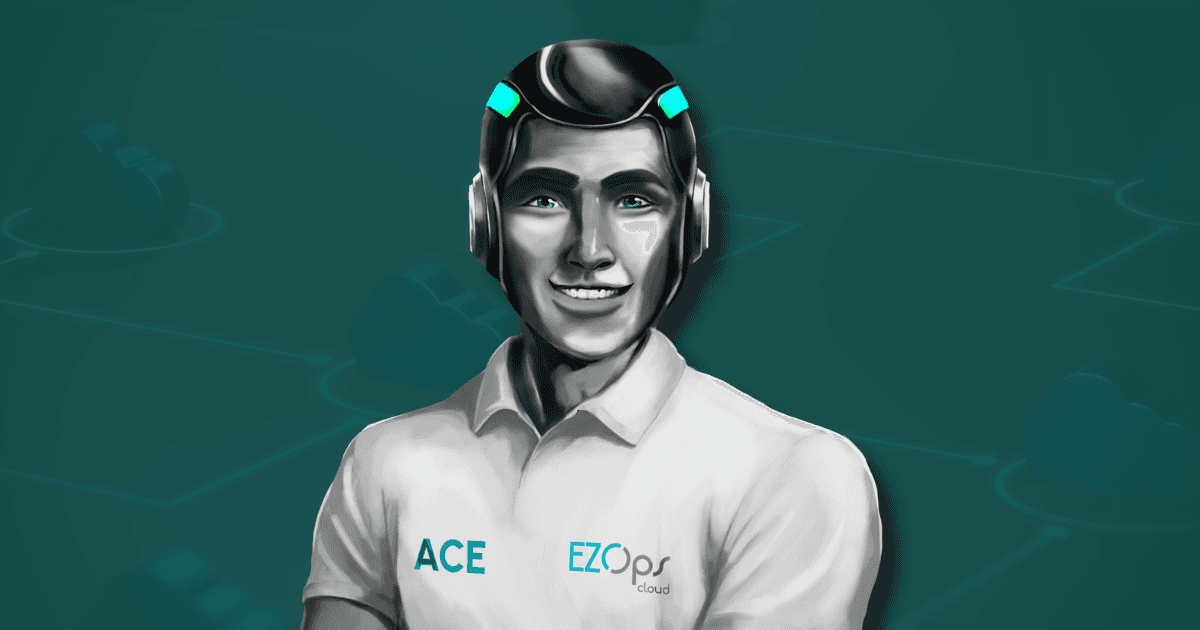
Now imagine a different model. While siloed teams miss signals, ACE Dev, our Automated Cloud Engineer, monitors infrastructure continuously. It detects configuration drift, unusual access patterns, and permission creep in real time, and acts within defined guardrails.
The outcome is not just fewer incidents, but a structural shift from reactive security to security by design. Because without shared responsibility and full visibility, organizations don’t just build technical debt, they build security debt. And that is the most expensive kind to repay.
How EZOps Cloud enforces Zero Trust by design
At EZOps Cloud, we believe security should be embedded, not bolted on. That belief is reflected in how we built ACE Dev, our Automated Cloud Engineer, to operate under Zero Trust principles by default.
Here is how this is enforced across our workflows:
IAM policies follow least-privilege by design.
Every infrastructure action is logged, auditable, and reversible.
Patch management is continuous, not periodic.
Misconfigurations are detected and flagged in real time.
No change is executed without validation and rollback mechanisms.
This is not merely a tooling decision. It is our culture encoded into infrastructure.
How to start building a DevSecOps culture
For CTOs and tech leaders, DevSecOps is not about adding more processes. It is about aligning mindset, tooling, and automation so security becomes part of daily work, not an exception. Here is a practical way to begin:
1. Map your current risk surface
Visibility comes first. Audit IAM roles, public endpoints, storage permissions, and outdated services. Platforms like ACE Dev can automate this discovery, reducing blind spots from the start.
2. Shift security left and right
Introduce static code analysis and secrets scanning into CI/CD pipelines, but also monitor environments post-deployment. Security does not end at release.
3. Automate patching and policy enforcement
Manual remediation does not scale. Automation ensures vulnerabilities are addressed quickly and consistently, without waiting for the next sprint.
4. Invest in team awareness
DevSecOps is cultural. Workshops, onboarding documentation, and shared practices matter. Security must become part of daily engineering habits.
5. Implement Zero Trust access control
Eliminate shared credentials and admin-by-default models. Enforce role-based access, session controls, and continuous auditing across environments.
DevSecOps is not extra work. It’s smarter work
A mature DevSecOps culture leads to fewer surprises, faster incident response, and infrastructure that scales securely. For technology leaders, it is the difference between reacting to vulnerabilities and preventing them by design. Security becomes an enabler of speed, not a brake.
Final thought
Security is no longer a checklist or the responsibility of a single team. It is something every engineer contributes to, every day. With the right mindset, operational discipline, and tools like ACE Dev from EZOps Cloud, DevSecOps becomes your default, not your aspiration.
Are you ready to make your infrastructure secure by design? Talk to our team and take the first step now.

EZOps Cloud delivers secure and efficient Cloud and DevOps solutions worldwide, backed by a proven track record and a team of real experts dedicated to your growth, making us a top choice in the field.
EZOps Cloud: Cloud and DevOps merging expertise and innovation