




Building reliability in the age of AI: practical strategies for SREs
AI & Modern Engineering Practices
Practical strategies for modern Site Reliability Engineers working with AI-driven production systems. This article explores failure modes of AI models, observability in GenAI pipelines and techniques for improving reliability in ML-driven environments.
If your team is deploying or maintaining AI-powered systems, this guide helps you strengthen SRE practices, reduce silent failures and design systems that are robust, explainable and production-ready.
We read the article “AI Reliability Engineering: Welcome to the Third Age of SRE” by The New Stack and found the discussion highly relevant. Inspired by that piece, we decided to go further and add a more hands-on, operational perspective grounded in real-world experience.
After a decade working with cloud architecture and DevOps reliability, we believe that artificial intelligence introduces operational challenges that require a more explicit reliability mindset from SRE teams.
AI is no longer experimental. It is embedded in critical production systems. As a result, SRE for AI now extends beyond infrastructure and application metrics to include model behavior, drift and decision quality. This shift fundamentally changes how incident management and reliability must be approached.
1. Understand the new failure modes of AI
AI systems fail differently from traditional software. Instead of crashing, they may hallucinate, degrade silently or behave inconsistently across similar inputs.
“In 2023, a Stanford HAI study showed that ChatGPT's ability to solve math problems fluctuated significantly across model updates.”
For SRE teams working with AI, this means expanding reliability practices to include:
Behavioral testing: check for hallucination and divergence in responses.
Input sensitivity audits: monitor how inputs affect model performance.
Guardrails and fallback logic: define safe behaviors for when the model fails.
Understanding these failure modes early enables faster root cause analysis and improves time to resolution (MTTR) when incidents occur. This mindset shift is essential as organizations integrate AI into more user-facing products, and it starts with the same context engineering discipline that makes AI systems interpretable in the first place.
2. Design for observability in AI pipelines
Observability no longer stops at infrastructure. You need transparency into:
Which model version was used.
What prompt triggered what output.
Response latency and confidence levels.
Drift in results over time.
“Netflix's ML infrastructure team uses a system of shadow deployments to test new models against real traffic in real time before replacing production models.”
Your observability stack for GenAI should include:
Model version tagging.
Prompt logging with sanitization.
Metrics around token use, cost, latency and error rates.
Building this visibility empowers engineering teams to trust what the model is doing and course-correct when performance shifts. Without it, detecting regressions becomes reactive rather than proactive, and by the time users are impacted, the window for prevention has closed.
3. Treat GenAI as a probabilistic system
Unlike deterministic systems, GenAI behaves probabilistically. The same input may yield different outputs depending on model state and context.
Effective SRE practices for AI acknowledge this reality by:
Logging output distributions, rather than outcomes alone.
Applying confidence thresholds.
Introducing human-in-the-loop approvals when needed.
“Airbnb applies confidence scoring to ML outputs and defers to human review when uncertainty rises, reducing risk without blocking innovation.” This approach transforms probabilistic behavior into a manageable reliability variable rather than an unknown liability.
4. Build infrastructure that supports iteration
Models evolve rapidly. Your platform should:
Allow safe rollout and rollback of models.
Support A/B and shadow testing.
Enable fast re-training and versioning.
“Uber's Michelangelo platform is a benchmark here. It enables ML teams to deploy models with CI/CD practices while maintaining tight integration with monitoring and alerting systems.”
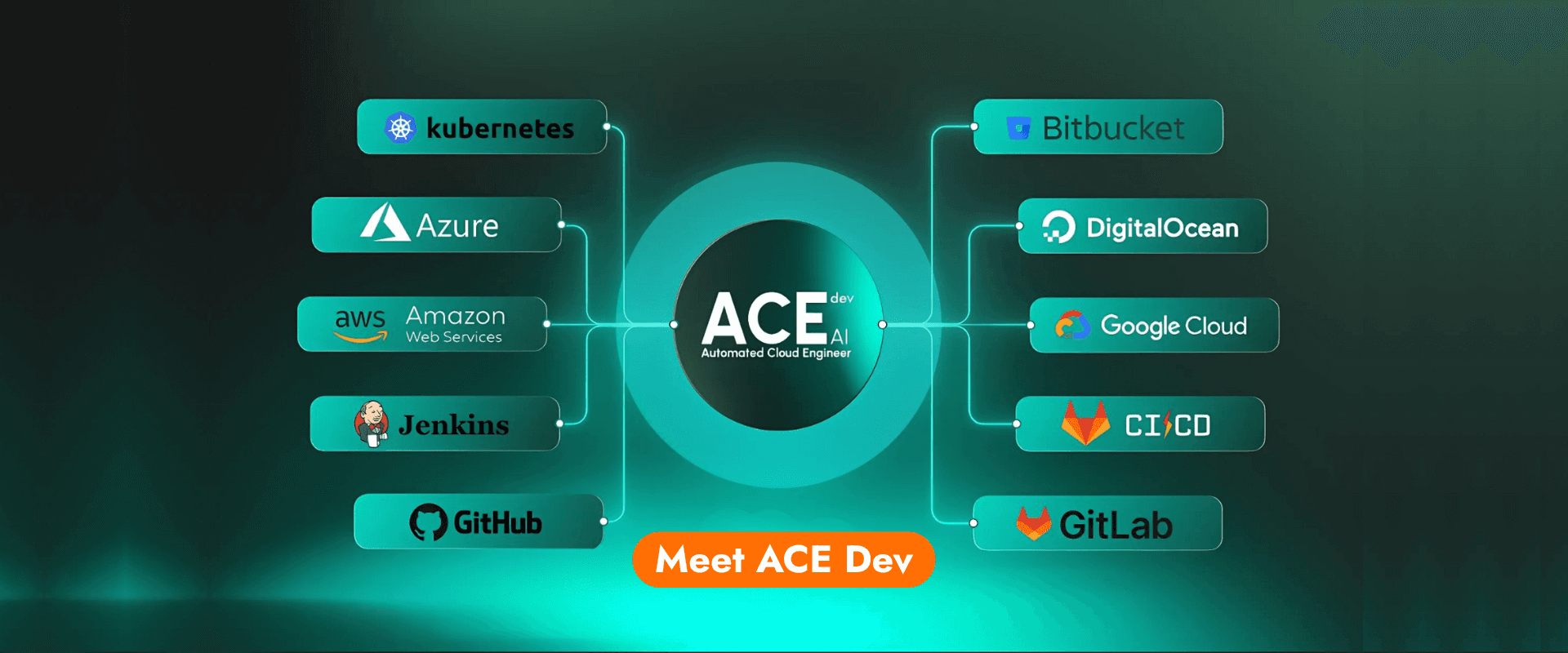
At EZOps Cloud, we follow similar principles to evolve our AI agent, ACE Dev, continuously in production environments. ACE Dev is an Agentic AI cloud engineer backed by human intelligence and built to coexist with the expertise of DevOps professionals.
Infrastructure built for change is the only kind that survives in a GenAI-driven world. Iteration must be frictionless, or innovation stalls at the proof-of-concept phase. AI must enable great developers, rather than overwhelm them.
5. Add AI-specific reliability layers
At EZOps Cloud, we design AI agents with reliability as a core requirement. For ACE Dev, this includes:
Role-based access control (RBAC) for all AI operations.
Audit logs for every decision the AI makes.
Synthetic tests to simulate prompts and edge cases.
Real-time monitoring of AI-driven actions.
These layers strengthen incident management and allow faster, more confident incident response when anomalies occur.
AI requires more than monitoring. It requires interpretability, limits and accountability. That is how SRE for AI evolves from theory into production reality.
FAQ
Q1. How is SRE different for AI-powered systems?
It extends beyond infrastructure and application metrics to include model behavior, drift and decision quality, since AI systems tend to degrade silently instead of crashing outright.
Q2. What does observability mean for a GenAI pipeline?
Visibility into model version, prompt-to-output mapping, latency, confidence levels and drift over time, not just infrastructure metrics.
Q3. Why treat GenAI as a probabilistic system?
Because the same input can produce different outputs depending on model state. Logging distributions, applying confidence thresholds and human-in-the-loop review turn that variability into something manageable.
Q4. What reliability layers does ACE Dev use in production?
Role-based access control, audit logs for every AI decision, synthetic tests for edge cases, and real-time monitoring of AI-driven actions.
Final thoughts
AI reliability is a systems problem that demands a blend of SRE rigor, ML understanding and product pragmatism.
At EZOps Cloud, we engineer reliability into every layer, from infrastructure to inference.

EZOps Cloud delivers secure and efficient Cloud and DevOps solutions worldwide, backed by a proven track record and a team of real experts dedicated to your growth, making us a top choice in the field.
EZOps Cloud: Cloud and DevOps merging expertise and innovation
